Arjun Menezes

Home / Fluid Dynamics Research / 3D Particle Tracking

3D Particle Tracking

Optical stereo-tracking 30mm³ particles a meter away, with tens of microns of precision.

Fluid Dynamics Research

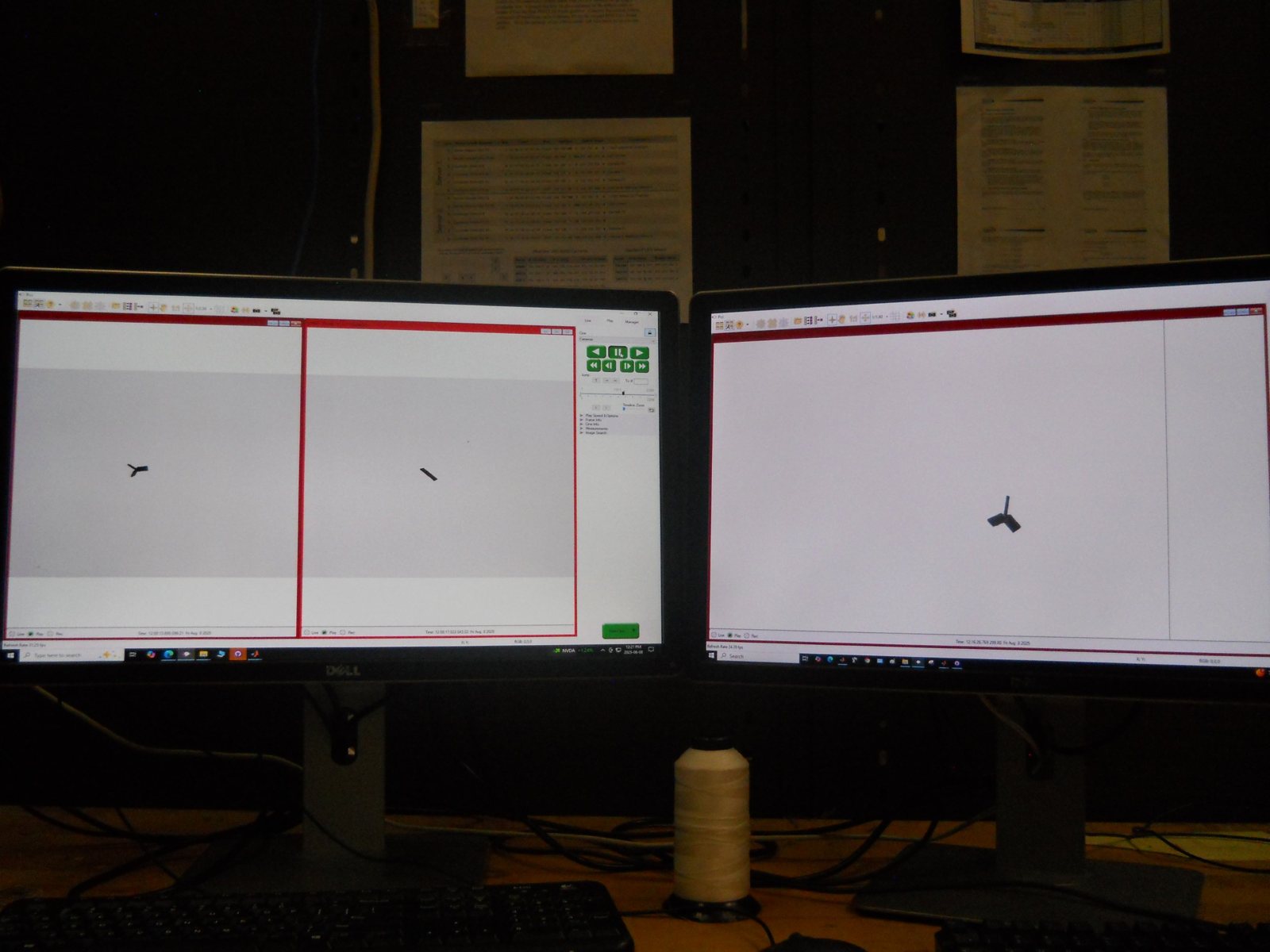
This project uses three high-speed cameras to precisely track the position, orientation, velocity, and rotation rate of a complex moving particle.

I developed this codebase using Samitha Sanjuka's methods for 3D particle tracking with four cameras in a turbulent water tunnel. We process video files from the cameras and stereomatch points on a 3D model with them. This allows us to perform 3D reconstructions and obtain precise measurements of trajectories of our 3D printed particles.

With precise tracking of position, orientation, velocity, and rotation, we can start to find mobility tensors of our particles.

Publications

Journal article2026

Bifurcations in Stokes Flow Sedimentation

Elias Huseby, Pierre Mathier, Meera Das, Arjun Menezes, Theo Witkamp, Ziqi Wang, Bernhard Mehlig, Greg A. Voth

Journal of Fluid Mechanics · Under review

DOILinkRelated project

Abstract and notes

Particles whose shapes couple translation to rotation display a rich array of behaviors as they sediment at low Reynolds number. We introduce a unifying perspective in which the possible dynamical regimes and bifurcations between them can be understood. We use experimental measurements of helical ribbons, with controlled center of mass offsets, to identify the key bifurcation from complex dynamics to a single attracting state as the magnitude of the offset increases. The sedimentation dynamics are very sensitive to small center of mass offsets, with the bifurcation occurring for offsets less than one percent of the particle length. Using mobility tensors obtained from immersed boundary method simulations, we simulate helical particle sedimentation and identify an alignment bifurcation surface, defined in the three dimensional space of center of mass offsets, that separates simple from complex sedimentation dynamics. Inside this surface we find limit cycles which emerge through Hopf and homoclinic bifurcations. Cocentered particles with coincident centers of force and mobility provide a reference case at the center of the bifurcation surface. We show how the geometric and dynamical symmetries of sedimenting cocentered particles are broken as the center of force offset moves away from the cocentered case. Three parity time-reversal (PT) symmetries exist for all cocentered particles under reflections normal to the eigenvectors of its translation-rotation coupling tensor. When a center of force offset preserves at least one of these PT symmetries, then there are closed orbits for particles inside the alignment bifurcation surface.
Talk2025

Preferential rotation of chiral particles in turbulence is driven by orientation dependent handedness

Samitha Sanjuka (presenter), Arjun Menezes, Greg A. Voth

American Physical Society Division of Fluid Dynamics (APS DFD)

LinkRelated project

Abstract and notes

We study the dynamics of chiral particles sedimenting in 3D homogeneous turbulence and how the dynamics depend on particle shape. We perform experimental measurements in a vertical water tunnel under influence of gravity and turbulence. In 3D turbulence that is approximately homogeneous and isotropic, we measure the translational and rotational dynamics of three-bladed propellers. We investigate key aspects of propeller dynamics, including position, velocity, rotation rate and the coupling between rotational and translational motion. The mean vertical component of the rotation rate of the chiral particles is nearly zero because of a cancellation between orientations with right and left handed translation-rotation coupling. However, when we condition the rotation rate on orientation, we find strong chiral coupling that depends on the orientation of the particle with respect to the relative velocity. We then compare the results with equivalent achiral particles.

Gallery

Experimental Setup
1 / 4

Experimental Setup

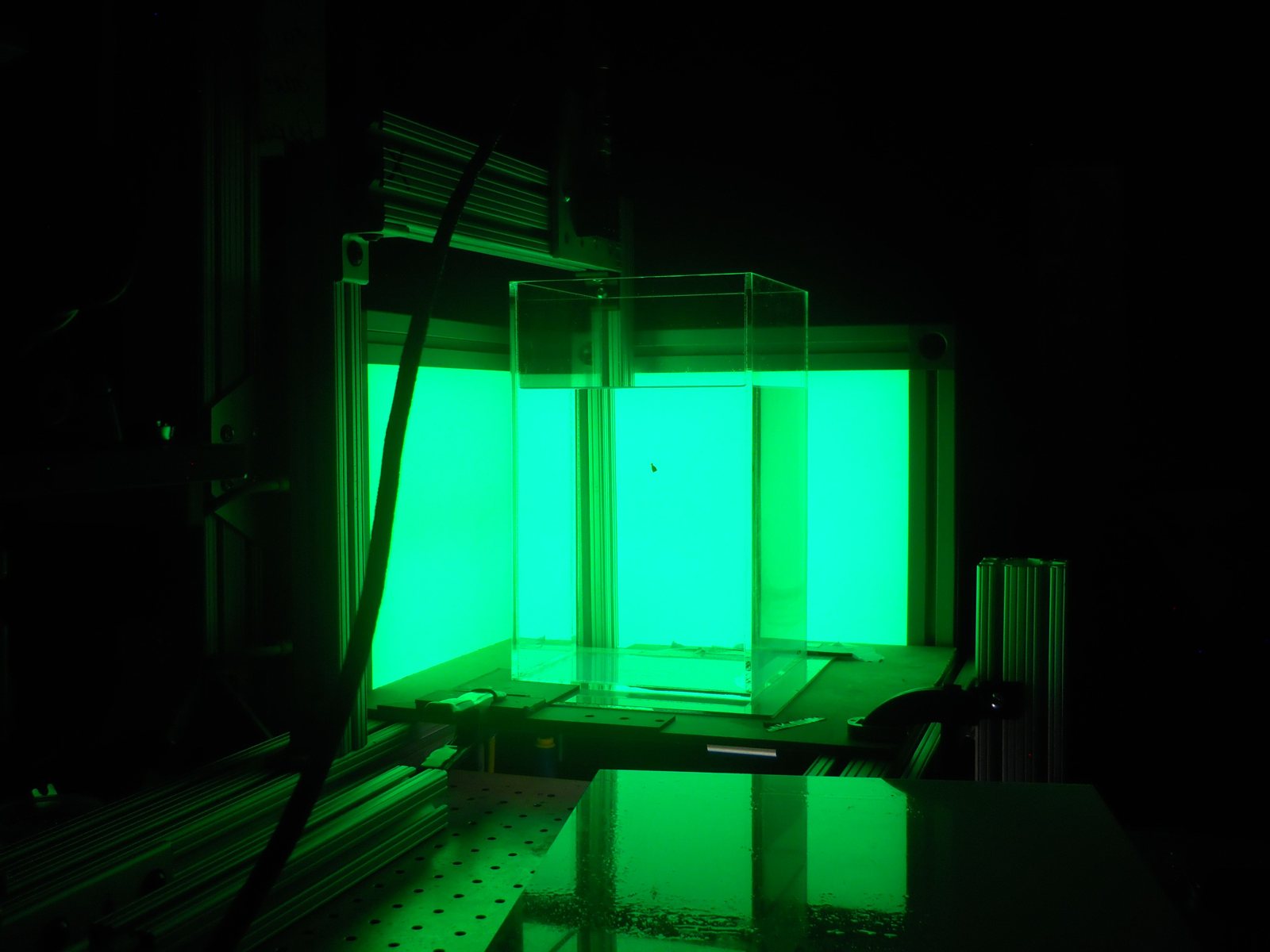
The cameras are out of frame to the left, right, and top of the image. There is a resin printed helical ribbon being tracked as it sediments in a tank of silicone oil.